
Quick answer: Chin surgery reshapes the chin so it balances with your nose, lips and jawline. The two main options are a chin implant (augmentation) and a bone procedure called genioplasty, which can move the chin forward, back or up and down. It is usually a day-care surgery, swelling settles over 2 to 4 weeks, and the final shape shows after several months. The right option depends on your bone structure, bite and goals, which is why a proper examination matters more than any package price.
This guide is written by the team at Kalosa Aesthetics and reviewed for accuracy by Dr. Ashish Khare, MCh Plastic Surgery, Gurgaon.
What is chin surgery?
Chin surgery, also called mentoplasty, changes the size, projection or shape of the chin. People usually consider it for one of three reasons: the chin sits too far back and makes the nose look larger, the chin is too long, wide or pointed for the face, or the jawline looks soft and undefined even at a healthy weight. The goal is balance. A well-planned chin does not stand out on its own. It makes the whole profile look more harmonious.
Types of chin surgery
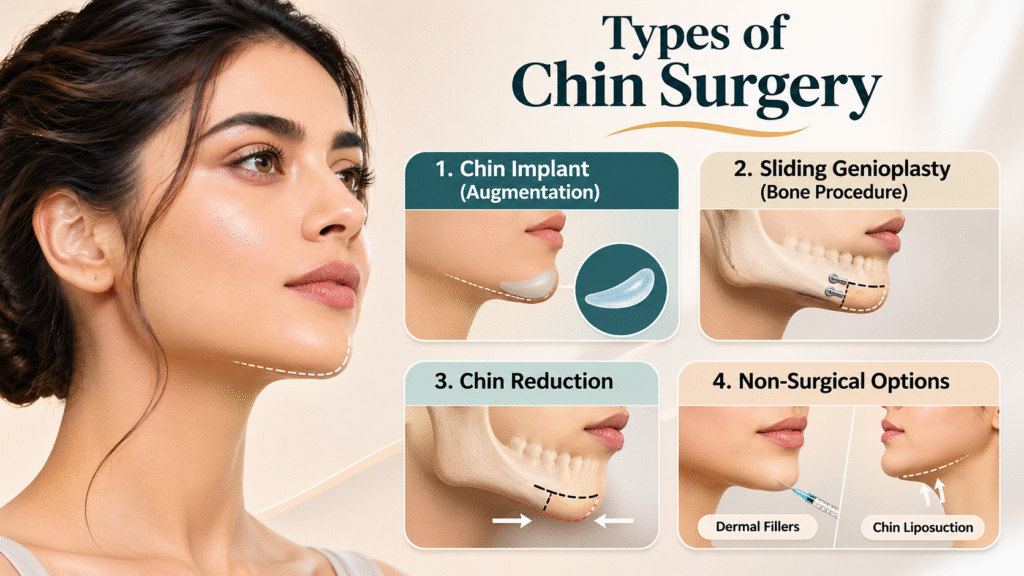
1. Chin implant (augmentation)
A small implant, usually medical-grade silicone, is placed in a pocket in front of the chin bone. It adds projection and can add some width or height depending on the shape. It suits people with a mildly to moderately recessed chin and a normal bite. It is the quicker option and can be removed or changed later if needed.
2. Sliding genioplasty (bone procedure)
The surgeon makes a cut in the lower part of the chin bone, slides it into a better position and fixes it with small plates and screws. This uses your own bone, so there is no implant to shift. It can bring the chin forward, move it back, shorten it or lengthen it, which makes it the more flexible option for larger corrections or for a chin that is too long.
3. Chin reduction
For a chin that is too prominent, wide or square, the bone is reshaped or repositioned. Reduction is planned carefully because it also affects the lower lip and the line of the jaw.
4. Non-surgical options
If you want a small change without surgery, dermal fillers can add temporary projection. They last months, not years, and cannot match what an implant or bone procedure does. See our page on non-surgical chin augmentation. If the issue is mainly fat under the chin, chin liposuction may be the better answer.
Implant or genioplasty: how to choose
- Small to moderate lack of projection: an implant is often enough.
- Chin that is too long, too short or off-centre: genioplasty gives more control.
- Bite problems or jaw misalignment: a dental or jaw assessment comes first, since the chin alone may not fix it.
- You prefer no implant: genioplasty uses your own bone.
Dr. Khare examines your face from the front and in profile, checks your bite and discusses what you want before suggesting one option. Details of the procedure are on our chin augmentation surgery page.
Who is a good candidate?
- Adults whose facial bones have finished growing.
- People in good general health with stable weight.
- Non-smokers, or those willing to stop before and after surgery.
- Patients with realistic expectations who want a natural improvement, not a different face.
How the surgery works
- Consultation and planning: photographs, a facial assessment and a discussion of options.
- Anaesthesia: local with sedation or general, depending on the procedure.
- Incision: under the chin or inside the mouth.
- Reshaping: the implant is placed, or the bone is moved and fixed.
- Closure and dressing: a support dressing is applied to control swelling.
Recovery: what to expect
- First 3 to 5 days: swelling, tightness and mild pain, controlled with prescribed medicines. A soft or liquid diet is advised, especially after inside-the-mouth cuts.
- Around 1 week: many patients return to desk work, though swelling is still visible.
- 2 to 4 weeks: most visible swelling goes down. Numbness of the lower lip, if present, starts to improve.
- About 6 weeks: contact sports and heavy exercise can usually restart if your surgeon agrees.
- 3 to 6 months: the chin settles into its final shape.
Timelines vary from person to person. Follow your surgeon’s instructions on diet, mouth care and sleeping with your head raised.
Risks and how they are reduced
Every surgery carries risk. With chin surgery the recognised ones are swelling, bruising, infection, temporary numbness, asymmetry and, with implants, shifting or the need for revision. Choosing a qualified plastic surgeon, an operating theatre set up for surgery and a clear aftercare plan lowers these risks. Be wary of anyone who promises guaranteed results.
Chin surgery cost in Gurgaon
The total depends on the technique (implant or bone), the type of implant, anaesthesia, hospital charges, tests and follow-up care. Costs differ a lot between clinics because the surgery and the surgeon’s experience differ too. Instead of a headline price, ask for a written estimate that lists what is included. At Kalosa, you receive one after your consultation with Dr. Khare, with no obligation.
Questions to ask before you book
- Which option do you recommend for me and why?
- How many chin procedures do you perform in a year?
- What happens if I am not happy with the result?
- What does the estimate include, and what could add to it?
Frequently asked questions
Is chin surgery done under local or general anaesthesia?
Both are used. Small implant placements are sometimes done under local anaesthesia with sedation, while bone procedures such as sliding genioplasty are usually done under general anaesthesia. Dr. Ashish Khare recommends the option after examining your face and discussing your medical history. Most patients go home the same day or after one night.
Will I have a visible scar?
Usually not. Implants are commonly placed through a small cut under the chin or inside the mouth, and bone procedures are done from inside the mouth. A scar under the chin sits in the natural crease and fades to a fine line in most patients.
How long does chin surgery take?
Around one to two hours for an implant, and one and a half to three hours for a bone procedure, depending on the plan and whether another procedure is done at the same time.
Can chin surgery be combined with a nose job?
Yes. Chin and nose are often planned together because the chin changes how the nose looks in profile. Combining them is a decision made on safety and on what your face needs. Read more on our rhinoplasty page.
What are the risks of chin surgery?
Swelling, bruising, temporary numbness of the lower lip and chin, infection, implant shift and asymmetry are the recognised risks. Careful planning, correct implant size and following aftercare instructions lower these risks, but no surgeon can promise zero risk.
How much does chin surgery cost in Gurgaon?
The cost depends on the technique (implant or bone), the implant used, anaesthesia, hospital charges and whether other procedures are added. A fixed number quoted without examining you is not reliable. At Kalosa you receive a written estimate after your consultation.
Plan your chin surgery with Dr. Ashish Khare
If you are thinking about chin surgery in Gurgaon, a consultation will tell you which option suits your face. Book a consultation or chat on WhatsApp.
This article is for general information and is not a substitute for medical advice. Results and recovery vary from person to person.