Gynecomastia grades describe how far the male breast enlargement has progressed, from a small button of tissue under the nipple to a full, sagging, female-looking chest. Grade 1 and 2 are mild to moderate, while grade 3 and 4 usually involve extra skin and often need surgery. The grade does not decide everything, but it is one of the first things I look at when a patient walks in.
If you have been searching for gynecomastia grades (1 to 4), you probably want to know one thing: is my condition bad enough for an operation? The honest answer depends on the type of tissue, how long it has been there, and how much it bothers you. Let me walk you through it.
What do gynecomastia grades actually mean?
Grading is a simple way for surgeons to describe size, shape and skin laxity. It helps us plan the treatment and explain it clearly to you. It is not a medical score of how dangerous the condition is, because gynecomastia is usually harmless to health.
One thing to know: there is no single universal system. Some surgeons use a three-grade scale, others use four grades, and the descriptions differ slightly. The four-grade version below is the one patients most often come across.
Gynecomastia grades 1 to 4 explained
| Grade | What it looks like | Usual approach |
| Grade 1 | Small, firm button of tissue behind the nipple, no extra skin | Observation, or liposuction and gland removal if it bothers you |
| Grade 2 | Moderate enlargement spreading beyond the nipple area, little or no extra skin | Liposuction with gland excision |
| Grade 3 | Marked enlargement with mild to moderate loose skin | Gland removal and liposuction, sometimes skin tightening or removal |
| Grade 4 | Large, sagging breast with significant excess skin, resembling a female breast | Surgery with skin removal, planned individually |
These are general descriptions. In real life, many men fall somewhere between two grades, and that is perfectly normal.
Grade 1 gynecomastia
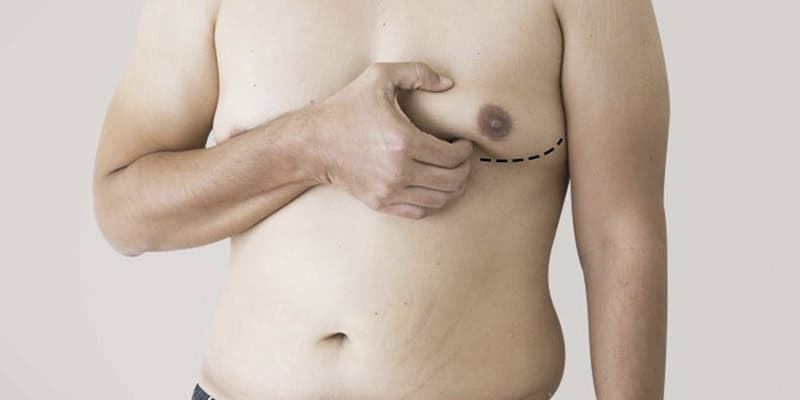
This is a small, rubbery or firm lump right under the nipple. The chest contour is otherwise normal. Many teenage boys have this during puberty, and it often settles on its own over a year or two.
Grade 2 gynecomastia
The enlargement now extends past the edge of the areola and is visible under a T-shirt. The skin is still reasonably tight. This is the stage where many men start thinking about surgery.
Grade 3 gynecomastia
The chest is clearly enlarged and the skin begins to hang. The nipple may sit lower than normal. Here, removing only fat and gland may leave some looseness, so we discuss skin tightening or removal during the planning visit.
Grade 4 gynecomastia
This is the most advanced stage, with a drooping breast and a fold below it. Treatment almost always includes removing excess skin, which means longer scars. Results can be very satisfying, but the surgery is more involved.
Which gynecomastia grade needs surgery?
There is no fixed cut-off. Medication-free, long-standing enlargement does not shrink on its own, and exercise cannot remove glandular tissue. As a rough guide:
- Grade 1: often watched for a while, especially in teenagers or when a clear trigger is being corrected.
- Grade 2: surgery is a common choice once the condition has been stable for months and is affecting confidence.
- Grade 3 and 4: non-surgical options rarely give a satisfying result, so surgery is usually the realistic route.
The decision is yours as much as mine. If the condition makes you avoid swimming, the gym or a simple shirt, that matters, whatever the grade.
Fat, gland or both: why the tissue type matters
Gynecomastia can be mostly glandular tissue, mostly fat (sometimes called pseudo-gynecomastia), or a mix. A man with extra chest fat may improve with weight loss, while glandular tissue will not. During your examination I check by touch and sometimes recommend an ultrasound to see what we are dealing with.
This is why two men with the same grade can need quite different operations. You can read more about the basics in our guide on gynecomastia surgery in India.
Treatment options by grade
Surgery is tailored, but these are the building blocks:
- Liposuction to remove excess fat from the chest and its edges.
- Gland excision through a small cut at the edge of the areola to take out the firm glandular tissue.
- Skin management for higher grades, which may mean skin tightening or removal of excess skin, with longer scars.
- Nipple repositioning in a few advanced cases where the nipple has dropped.
Not everyone needs all four steps. Lower grades often need only the first two.
Before you decide: causes worth checking
Gynecomastia is linked to hormone changes, some medicines, weight gain, alcohol or substance use, and certain medical conditions. Sometimes no cause is found. If the enlargement is recent, painful, one-sided or hard, please get it checked before thinking about surgery.
A good consultation should include your history, medicines and a physical examination. Blood tests are sometimes advised.
Recovery after gynecomastia surgery
Most men go home the same day or the next day. You will wear a compression garment for a few weeks to control swelling and help the skin settle. Light work is often possible within about a week, but heavy lifting and chest workouts need to wait until your surgeon clears you. Swelling can take weeks or months to fully go down, so early results are not final.
Any surgery carries risks, including bleeding, fluid collection, infection, uneven contour or changes in nipple sensation. Your surgeon should discuss these openly with you.
When to call your surgeon
Contact the clinic promptly if you notice any of these after surgery:
- Fever, or redness and warmth spreading around the wound
- Sudden one-sided swelling or a tight, growing lump
- Pain that is getting worse instead of better
- Pus or a bad smell from the incision
- Chest pain or breathlessness (seek emergency care straight away)
Frequently asked questions
Can gynecomastia go away without surgery?
Mild cases, especially in teenagers, can settle by themselves. Long-standing glandular tissue usually does not. Weight loss can help if fat is the main component.
Is grade 4 gynecomastia curable?
It can be treated surgically, and most men notice a big change in chest shape. Because skin is removed, scars are longer, and your surgeon will explain this beforehand.
Can I tell my own grade at home?
You can get a rough idea, but only an examination shows how much is gland, fat and skin. Self-grading often misleads, so a clinical opinion is worth it.
How much does treatment cost?
The cost varies with grade, technique, hospital and anaesthesia, so any figure online is only approximate. After a consultation you will get a clear estimate, and EMI options are available.
Take the first step with a proper assessment
If you are wondering where you stand, a personal examination will answer it far better than any article. You are welcome to meet Dr. Ashish Khare, discuss your options without pressure, and decide at your own pace.
This article is general information and is not a substitute for a personal medical assessment.